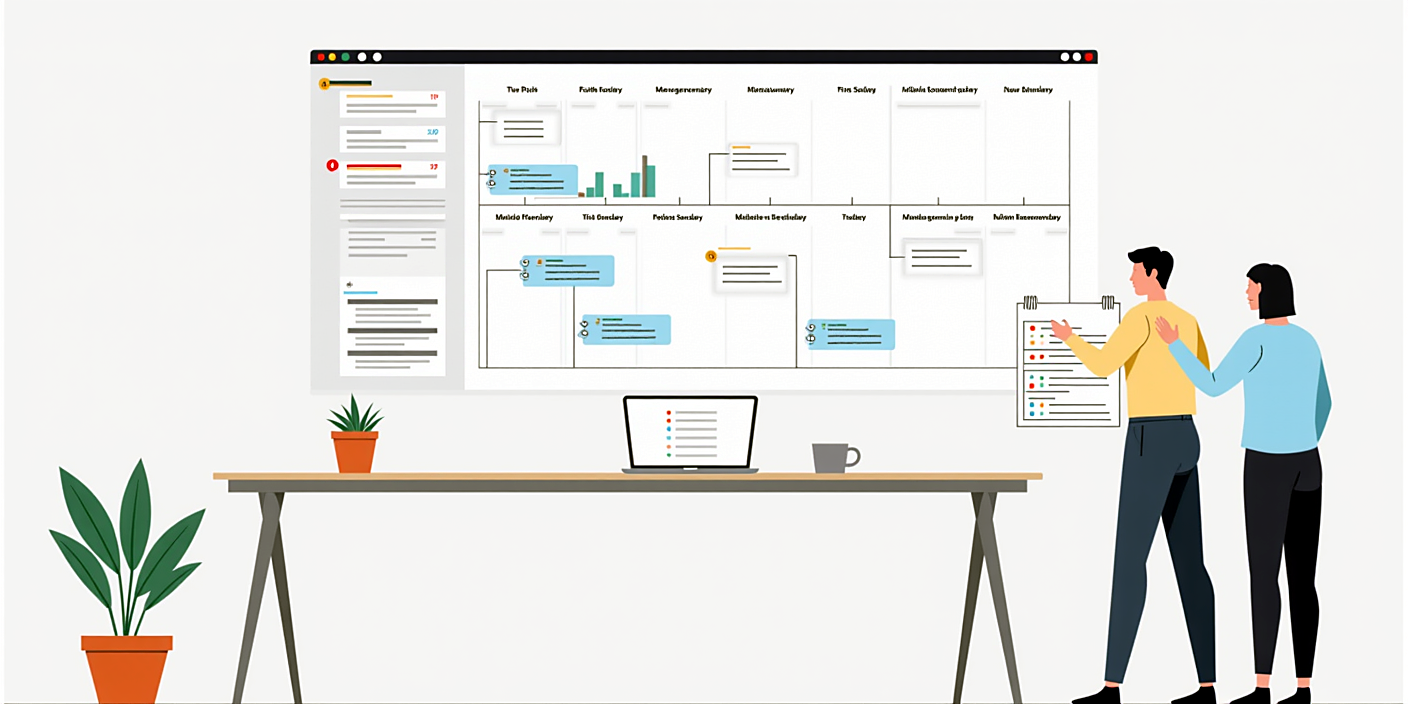
Setting goals and ways to achieve them: measurable results and testing system
Create a "result → stage → checklist" system that clearly defines the goal, methods to achieve it, measurable criteria and time frame.
Purpose Setting: Building a Results Measurement System
The way of setting and achieving goals should be such that you can answer the question "How close did I get?" accurately. For this, it is necessary to link the goal with the achievable result, measurement criteria, and time frame.
The most practical approach - formulating a result as an "measurable outcome". For example, changing jobs in general; within 3 months reviewing 12 job offers and getting at least two interviews are verifiable.
Not SMART but work with the formula that requires verification
The SMART approach is widely used, but what you need is not "language" but "verification". Add the following minimal triplet: result (what), measurement (how it's measured), time frame (by when).
- Result: final outcome (e.g., completing a course, product launch, establishing healthy habits).
- Measurement: number or specific criteria (e.g., "three times per week", "30 days", "at least two interviews").
- Time frame: exact date according to the calendar or a weekly/monthly limit.
Structure: From Goal to Daily Actions
The main reason why achieving goals is difficult - there's an "unexplained gap" between goal and daily tasks. To eliminate this gap, break down your goal into steps and prepare a specific list of actions for each step.
A good system relies on the chain: result → stage → checklist. In every stage have at least one verification point: outcome or measurement indicator.
Three-layer plan: annual goal, quarterly phase, weekly task
The following layers are suitable for most people because they maintain control and prevent plans from "slipping away".
- Annual Goal: One main direction (e.g., skill development, increasing income).
- Quarterly Phase: 2–4 results (e.g., "completing a course module", "adding three projects to the portfolio").
- Weekly Task: 3–5 specific actions (e.g., "practicing practical skills for 45 minutes every day", "preparing one interview practice per week").
If you increase the number of weekly tasks, they will be less likely to get done. Usually, three to five tasks are realistically manageable.
Back to History: Psychological Roots of Goal and Planning
Achieving goals approaches have been shaped in psychology through several directions. One of the most practically valuable ideas is to see a goal not as an "intention" but as a "goal-oriented plan".
Theories and research on motivation and goal mechanisms began developing from mid-20th century, later merging with practical management methods.
Main turning points (dates and sources)
- 1954: Peter Gollwitzer's work on the relationship between intention (intentions) and subsequent action marks the beginning of scientific streams that emphasize this connection; later, the concept of "implementation intentions" (conditions for initiating an action) was more precisely developed. This direction in psychology aims to strengthen the link between planning and action.
- 1990: Locke and Latham systematically presented goal theory (a collection of scientific papers and subsequent works). Their main conclusion: specific goals and high demands influence work performance positively.
- 1998: Atkinson, Brandt/Snyder expanded the directions on motivation and modeling action oriented towards a goal. In practice, this shows the necessity to bring "planning" down to an operational level.
These dates are not magic: understanding the mechanism of goals and transforming them into testable plans is a practical step that yields results.
Mechanism for working: plan-test-correct cycle
Achieving goals usually occurs through repeated cycles, rather than one-time "motivation": you make a plan, perform it, measure the result, and adjust. If this cycle does not work, over time your goal will fade into just a desire.
Use the following mechanism: every week assess results, then align next week's tasks accordingly. This approach gives an adaptable plan rather than a "rigid" one.
Four-stage cycle (weekly)
- Stage 1 (Plan): Select 3–5 most important tasks for the week. Each task should have a completion criterion (for example, "fixing two errors", "completing one section").
- Stage 2 (Execution): link the task to time blocks (e.g., 45 minutes per day).
- Stage 3 (Testing): write down the percentage of planned and completed tasks. Without measurement, correction is not possible.
- Stage 4 (Correction): identify the cause: was there insufficient time? Was the topic too difficult? Or was the plan overly ambitious?
Diagnostics for "Why isn't it working?"
In many cases, failure is not due to incorrect goals but rather three types of problems: tasks are too large, testing does not exist, or the sequence is wrong. Every time try to find the first cause.
| Sign | Possible Cause | C correction Method |
|---|---|---|
| Nothing "completed" at the end of the week | The tasks are too big or vague | Add a "completion criterion" and split the task into chunks that can be completed in 1–2 days |
| I did it, but there is no result | Not doing the right thing | In accordance with the result measurement, replace the task with an activity that contributes to the outcome |
| Motivation drops | The plan is "not easy to start" | Include a minimal 10–15 minute version for daily starting |
Practical Part: Preparing the Goal and Setting Up the Plan
The following practical guide will help you turn your goal from paper into reality. The most important thing is to start small enough that you can see results even in the first week.
For example, instead of "I will increase my income professionally," a measurable result such as "I will prepare 3 portfolio projects I present within 8 weeks" would be chosen.
Step 1: Write down your goal with measurement (prepared template)
Fulfill the following template. It must be short and precise.
- Goal: (what result)
- Measurement: (number/criterion)
- Durability: (week/month/date)
- Limits: (available time per day/week)
Step 2: Link the weekly task to a time block
After selecting the task, assign it a time block. For example, if you have 15 hours per week, this would be divided into 45 minutes each day over 20–21 days. This plan also resolves when the task will be completed.
If real-time is limited, shorten the task but keep the measurement. Otherwise, the plan fails and confidence for the next cycle disappears.
Step 3: Add a "trigger condition" to turn it into a habit
In accordance with the implementation intention idea, write down your condition of "when I will start." This kind of condition automates planning.
- Example: "If it is 19:30, I will begin my practical assignment for 45 minutes."
- Example: "After work, I write down for 10 minutes: what did I learn today and what am I going to do tomorrow."
Typical Errors and Specific Corrections
- Error: Writing the goal only in result without giving a path.
Correction: Add 2–4 results per quarter stage. - Error: Referring to tasks as processes such as "I read," "I prepare."
Correction: Specify the number of chapters, type of material format and final result. - Error: Not performing weekly checks.
Correction: Write a 5-minute measurement table at the end: completed/not completed, reason.
Accelerating the Journey: Criteria for Selecting Resources
In achieving your goals, it's not the quantity of action that matters but the selection of resources. If you don't determine which task will have "the greatest impact," time will slip away.
The following criteria can help: how directly a task is linked to the outcome, how quickly completing it provides feedback and makes subsequent steps easier.
Three Criteria (Impact, Speed, Enablement)
- Impact: How close is this task to achieving the result?
- Speed: After completion, do you quickly "get information" (can you see results)?
- Enablement: Does it open up the way for future weeks (e.g., experience, materials, skills are gathered)?
If all three criteria are low, shorten or defer the task.
FAQ
Can I write goals in the same way as daily tasks?
No. A goal must be result-oriented (with time and measurement). A daily task is a piece that serves the goal. The right approach: Goal (result) → Week (piece) → Day (step).
If the plan is good, why does it still get dropped anyway?
Usually because starting the task is difficult or there's no check-in. Add a "10–15 minute minimal version" to start and measure at least once per week whether it was completed.
Should I update or rewrite an expired goal?
Check the results of your review. If time and measurement are aligned, just shift the deadline. If the right task wasn't chosen for achieving the result, restructure the quarterly steps (change the logic of tasks).
If there's no motivation, how can I continue working?
Don’t rely on motivation but commit to a condition: "If time allows, take minimal step." A minimal step usually reduces daily load and keeps momentum going.
How many goals should you focus on?
Usually one main goal plus 1–2 additional directions is enough. If there are five or six different directions in a single week, measurement and check-ins become scattered and execution decreases.
What's the best way to measure weekly review?
The simplest option: write "completed/not completed" for three to five tasks per week along with one reason (time, complexity, unclear direction). Then enter specific corrections in next week’s plan.
Conclusion
A successful approach to goal setting is turning it into a measurable result and linking it to the weekly review and correction cycle. Motivation may come or go but the cycle keeps you moving steadily forward.
The best step to take today: choose one goal, write it with measurement and deadline, then schedule three to five weekly tasks in time blocks that serve this goal.